
The amount of accumulated amortization appears in the balance sheet as a contra account that offsets the intangible assets line item. The intangible assets line item is located within the fixed assets block of line items in the balance sheet. An example of how amortization expense is presented in an income statement appears in the following exhibit.

Types of Companies With Intangible Assets
Amortization helps companies allocate the cost of such intangible assets over their useful life, ensuring accurate financial reporting and better decision-making. In addition, the amortization process rarely assumes that there will be any salvage value at the end of an asset’s useful life, while this is a distinct possibility for a tangible asset. A third difference is that amortization is usually calculated on the straight-line basis, while accelerated depreciation is commonly applied to tangible assets. Intangible assets are generally considered long-term and their value can increase over time. An intangible asset like a brand name can be critical to a company’s long-term success. For example, a company may create a mailing list of clients or establish a patent.
Purchased intangible assets
The annual depreciation expense on a straight-line basis is the $32,000 cost basis minus the expected salvage value—in this case, $4,000—divided by eight years. The annual deprecation for the truck would be $3,500 per year, or ($32,000 – $4,000) ÷ 8. This exclusive right enables the owner to manufacture, sell, lease, or otherwise benefit from an invention for a limited period. Protection for the patent owner begins at the time of patent application and lasts for 17 years from the date the patent is granted. Goodwill is the portion of the purchase price that is greater than the fair market value of the assets and liabilities of the company that was bought. Goodwill is meant to capture the value of a company’s brand name, customer base, relationships with stakeholders, and employee relations.
- Tangible assets may have some value when the business no longer has a use for them.
- Any unauthorized use of intellectual property is called infringement.
- Included in the acquisition cost are the purchase price and any fees.
- The maximum amortization period for intangible assets typically aligns with their legal or useful life.
- It represents the value today of the excess earnings of a particular enterprise.
Where Do You Find Amortization of Intangibles on a Company’s Financial Statements?
The formulas for depreciation and amortization are different because of the use of salvage value. The depreciable base of a tangible asset is reduced by its salvage value. This is often because intangible assets don’t have a salvage value. Physical goods such as old cars that can be sold for the expensing of intangible assets is called scrap and outdated buildings that can still be occupied may have residual value. Depreciation is recorded to reflect that an asset is no longer worth the previous carrying cost reflected on the financial statements. Both methods appear very similar but they’re philosophically different.
Part 2: Your Current Nest Egg
If the market value of goodwill is found to be lower than the book value, then goodwill needs to be reduced to its market value. If goodwill is impaired, it is reduced with a credit, and an impairment loss is debited. Internally developed intangible assets do not appear on a company’s balance sheet. When intangible assets have an identifiable value and lifespan, they appear on a company’s balance sheet as long-term assets valued according to their price and amortization schedules. Unlike intangible assets, the value of tangible assets is easier to determine.
Percentage depletion and cost depletion are the two basic forms of depletion allowance. The percentage depletion method allows a business to assign a fixed percentage of depletion to the gross income received from extracting natural resources. The cost depletion method takes the basis of the property into account as well as the total recoverable reserves and the number of units sold. Tangible assets can often use the modified accelerated cost recovery system (MACRS). The same amount of expense is recognized whether the intangible asset is older or newer. Tangible assets may have some value when the business no longer has a use for them.
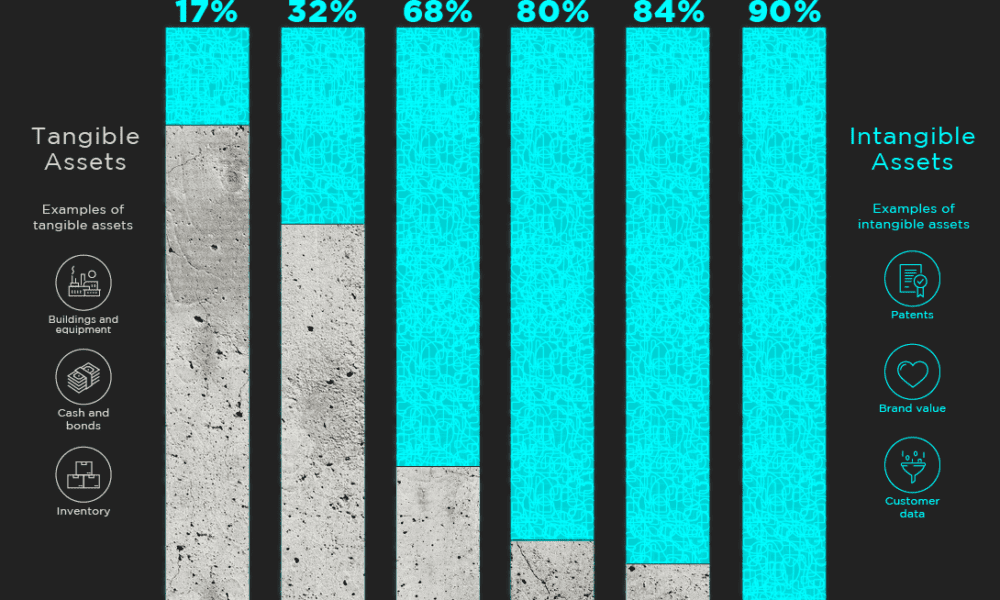
Tangible assets are the easier to account for because they normally have a finite value and life span. As they are used up, an expense representing this use gets carried over to the income statement. Intangible assets are often intellectual assets, and as a result, it’s difficult to assign a value to them because of the uncertainty of future benefits. Small business owners need to record amortization on their income sheets and claim it for tax write-offs. The IRS allows businesses to deduct amortized costs over an asset’s useful life, reducing taxable income.
To illustrate the concept of goodwill, assume that a group of investors purchased an electronic components manufacturing business. But when copyright is purchased by someone other than the creator, its cost may be substantial and should be capitalized. Research and development costs are expenditures incurred in discovering, planning, designing, and implementing a new product or process. If this were not the case, firms would not spend millions of dollars on these programs that they do. However, it is extremely difficult to measure the amount and life of the benefits generated by these programs. The below example presents types of intangibles that fall into these various categories.
Subsequent valuation of intangibles is at net book value, that is, at cost less accumulated amortization to date. Get granular visibility into your accounting process to take full control all the way from transaction recording to financial reporting. ABC Inc. utilizes the straight-line method of amortization, and each year they will record an amortization expense of $10,000. Accounting guidance determines whether it’s correct to amortize or depreciate. Both options spread the cost of an asset over its useful life and a company doesn’t gain any financial advantage through one rather than the other.
For example, patents are amortized over 20 years, while copyrights last the author’s life plus 70 years. Fixed assets are non-current assets that a company uses in its business operations for more than a year. They are recorded on the balance sheet, usually as property, plant, or equipment. They include assets such as trucks, machinery, office furniture, buildings, etc. The money that a company generates using tangible assets is recorded on the income statement as revenue.